
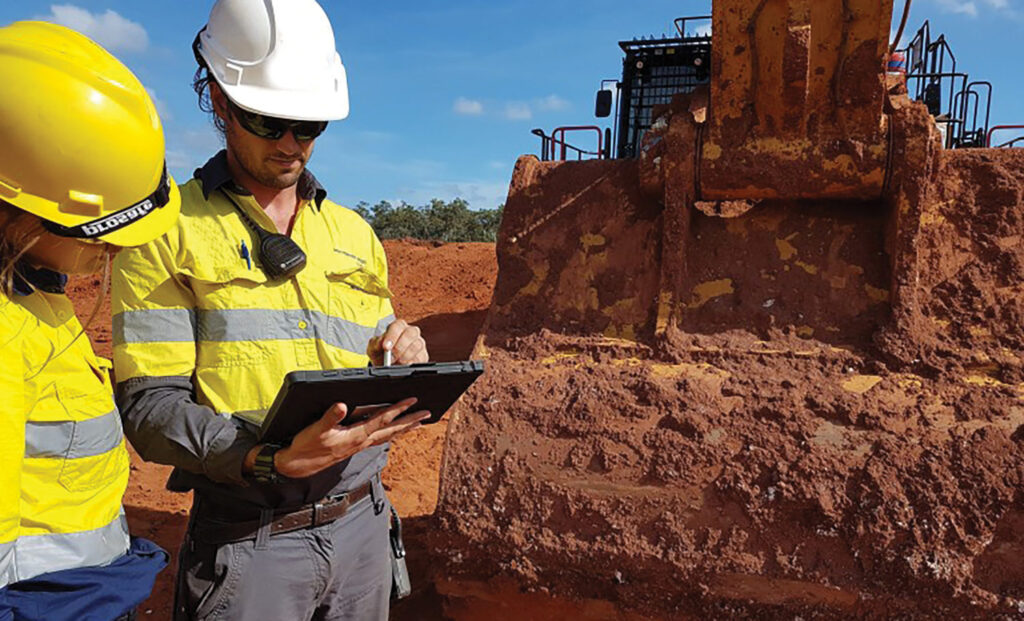
CiteOps Management System is not like others – it sticks when you need it to.
“If it’s not in CiteOps it doesn’t happen”
A manager on one of our operating sites said to a prospective customer the other day…
We implemented CiteOps (formerly Fewzion) at this site about six months ago. While I was driving through Middlemount early last week I spoke to a friend on the site. He told me they were celebrating a production record for the previous week. More than 300,000 tonnes of coal to the ROM. Pretty impressive! Four years ago, I helped install a traditional spreadsheet and whiteboard MOS here. The traditional MOS didn’t stick. CiteOps has…
CiteOps Management System is unlike the others.
When he says “IT” in the (if IT isn’t in CiteOps IT doesn’t happen) he means everything: production, maintenance, project and safety/training work. Do you have a system that get everyone on the same page? Is everyone working together to deliver results?
Check out the article below from Mining Magazine
– Mining Magazine Article –
Paul Moynagh is a founding director of Fewzion, which provides a work-management software system designed to help improve operational productivity. He tells Ailbhe Goodbody how frontline work-scheduling systems improve productivity.
Fusing production processes with Fewzion – MM Oct 2014 (1)
How can a work-scheduling software system such as CiteOps (formerly Fewzion) help mining companies to improve productivity, safety and control cost? And what are their advantages over using spreadsheets?
Most mines have good tools for planning the mine and what is supposed to happen in the next 4-16 weeks (the theory). They also have a lot of data about what’s happening in the mine. With SCADA and fleet-management systems, leaders aknow bout the performance of machines, where a machine is and even what it is doing (the reality).
At Commit Works, we believe that to improve performance you need to manage the frontline. Shift-by-shift work processes connects the theory to the practice. To do this you need to know the targets, tasks, people and equipment for each specific shift. Results are delivered by these people and equipment each shift.
CiteOps Management System bridges the gap
CiteOps is the bridge between the theory and the practice for all work. It is designed to help manage the work done by everyone on-site (from preparation to production and maintenance through to the plant) all in one resource-balanced plan. We don’t know of any other system that does that job.
CiteOps supports the whole ‘plan, do, check, adapt’ cycle from weeks down to shifts. There are screens and reports for planning the week, adapting plans for change each day, doing shift handovers and pre starts, managing a shift, entering actuals, closing off tasks and reviewing performance in daily review meetings. The group of spreadsheets, macros, whiteboards etc. required to do this outside of a proper software tool like CiteOps is frightening! It’s kind of amazing that many billion-dollar operations still run this way.
While we make life easier for planners by bringing in data from other planning systems (e.g. Excel and SAP), our focus is on getting a good plan in the hand of the supervisor. This is who is out there every day with their crew making the work happen.
Digitise your work management with CiteOps
With spreadsheets and whiteboards, people often put lists of tasks together for what to do each day. Within CiteOps, each of those tasks has a need for people and equipment. By visually comparing the roster and equipment schedules it is quickly evident if there is enough people and equipment to do the work each shift. This helps ensure everyone is kept productive and reduces clashes for equipment and skilled people.
CiteOps helps the supervisor engage their crew so that they can give feedback about what is and isn’t working. This means planners can create better plans. Crews believe the plans can be delivered, not (as I’ve seen many times) say “this is rubbish” then go and do something else. Having an easy-to-use tool in supervisors’ hands means people can make better decisions. It’s not just a top-down push – it’s top down and bottom up, and that makes the difference, I think.
Read more about collaborative planning here
How do you encourage employees to use CiteOps Management System properly?
Everybody says that ease of use is the key (particularly in mining). We have taken this to the extreme, and made the system ‘iPad simple’. There’s very little barrier to use. In many cases, people use it better than a pen and paper, or a whiteboard. Where you’ve got literacy issues or language barriers, there can be a lot of push back on manual, paper-based tools. The barrier to use needs to be very low, that’s what I think the difference is for supervisors while maintaining a powerful work-scheduling system for planners and engineers.
We are also careful with our language and don’t like to talk about ‘accountability’. Instead we say that “CiteOps makes everyone’s hard work visible”. So putting a tool like CiteOps into a mine supervisor’s hands helps them to not only influence their crew to get the work done but also helps influence the management team to better plan and co-ordinate the work.
When you put it in those terms, the buy-in is much stronger. Plus, to be honest, despite the cold hard fact that it is about improving performance, CiteOps also feels like a bit of a ‘bright shiny new thing’, so there are always people who are keen to give it a go.
Is it worth investing in tech?
Due to the global mining downturn, many mining companies are cutting back on expenditure. How do you persuade them to invest in a scheduling system at such a time? Fundamentally, we’re about improving the bottom line by managing processes better. A lot of the big cuts have already happened, so now companies are looking at how to operate their slimmed-down mines more efficiently. This means driving up productivity and driving down cost per tonne.
Getting on top of the process and what’s happening every day is one of the most powerful ways to do that. A scheduling system means you can actually manage that work, which makes it much more likely you’ll succeed.
CiteOps and Anglo American
CiteOps is being used at Anglo American’s Moranbah North mine in Australia’s Bowen Basin (winner of 2013 Australian coal mine of the year for a complete turnaround in performance). Anglo American has stated on its online investor page that in 2013 it improved longwall output at the mine by 39%. Their longwall now regularly runs at over 100 hours per week.
You certainly can’t attribute all of that to CiteOps – but you can attribute it to managing people, equipment and processes better, and CiteOps is a tool they use for that.
Mark Cutifani, CEO of Anglo American, regularly says he wants to bring manufacturing discipline to the mining industry. Moranbah North has set a high standard for this and the approach is being spread throughout the underground coal business. We intend to work with other mining verticals, and there is really no reason why CiteOps shouldn’t be used in open-pit mines or hard-rock underground mines right now.
How is Commit Works supporting consultancies?
We really enjoy working and collaborating with consultants and have built some strong relationships already. We understand that many of the benefits of CiteOps come when it is combined with effective consulting. That’s not to say that you can’t get benefits from the software on its own (many of our customers have), but together there is a force-multiplier effect.
Our focus is purely on building and supporting great software that people want to use. We don’t provide any competing consulting services so that we can work cleanly with consultants anywhere in the world, and geography is not an issue because CiteOps can be run from the cloud.
There are four elements that work together to improve the performance of an operation: the management system, tools, behaviours (the process of planning, doing, reviewing and improving) and leadership. Most consultants will work on all four of these elements during a project; however, the tools and systems are normally built up with spreadsheets, paper and whiteboards, which are often created from scratch during the project. At the start of a consulting project there’s a lot of effort and investment required to get people to use those tools.
Technology and people drive tangible results
With a modern web-based system like CiteOps, you can have the system up and running in a couple of days. People accept the system quickly because it saves them time, so the consultants can concentrate their effort on coaching for management behaviours, leadership and results.
Systems like CiteOps make consulting projects more effective and, most importantly, the system is many times more sustainable after the consulting project is finished.