
BY IAN JONES,
COMMIT WORKS HEAD OF PRODUCT
Mine planning systems and fleet management solutions capture what happened, but rarely why it happened. Even when operational decisions are captured digitally and connected to planning and execution data, AI can only explain outcomes without understanding intent. Artificial Intelligence in this context will be limited in its ability to support better planning, performance and safety.
As we move focus from collecting data to leveraging the information contained in the data through AI, we need to acknowledge that our datasets are incomplete. At Commit Works, we work to capture the decisions made throughout the operational planning process, often commencing at the Weekly Plan on a mine site.
The Three Pillars of Mining Data AI Needs
We are seeing three key pillars of data that support the types of analysis our client base is increasingly seeking. The Short-Term Mine Plan (supported by a summary maintenance plan), the Operational Plan, and Data Capture Systems (e.g. Fleet Management Systems).
The Short Term Mine Plan is a key plan developed by planning engineers. This plan sets a guide for all decisions made during the week and influences outcomes in the weeks that follow. It directs mining activities and is often centered on locations and major equipment. It forms the basis for Conformance to Plan reporting, foundational to meaningful future analysis.
The second is where we at Commit Works operate. We help mines create and manage an Operational Plan. This plan may start in a digital tool like PowerPoint, Microsoft Project or Excel, but key decisions are often made external to a digital platform. They are captured on paper, written on whiteboards, or penciled onto maps. In every case, these decisions impact the shift execution yet are rarely available for post-shift analysis.
Data collection solutions like Fleet Management Systems are highly integrated and collect vast amounts of data from sensors mounted throughout modern mining equipment. This data is often further categorised by input through operator inputs, GPS or radar systems. This result is rich, accurate data supporting Time Usage Models, Equipment Movements and utilisation analytics.
Implementing a solution that captures this rich data is essential. Once captured, it should be transferred to a structured data lakehouse. This will allow companies to answer questions that are currently only considered against statistical analysis of post shift results.
AI Can See Outcomes But Can’t Explain Them
Imagine a senior site manager asking an AI agent like ChatGPT, “How did we perform against target this week?”. Now imagine receiving a response that performance was 82% of target. The natural follow-up is, “Why did we miss target?”. This second question is where most operations are challenged. The reason isn’t immediately obvious, but it is simple. The data that explains operational decisions is not consistently captured digitally. Therefore, it does not exist in the data lakehouse. The AI agent can see outcomes, but it cannot see intent.
When a supervisor draws a border on a map to indicate a no-go area, this can dramatically change onsite equipment movement, task execution sequencing and generate additional tasks. A fleet-focused solution would conclude an underutilised fleet. However, reality may be that unplanned work delayed access to and work at the planned location. Without digitally capturing that decision-making process, reasons and context, an AI agent cannot explain the outcome.
Open Data Models and Industry Collaboration
There is a practical solution. Implement solutions that capture operational decision-making digitally through desktop solutions in the Control Room or mobile solutions used by Supervisors in-field. Once all tasks, actions and decision are captured, data can be moved to the data lakehouse and integrated with Mine Planning data and FMS outputs.
It is important to remember:
- A mine plan is an optimistic representation of intended work.
- A fleet system captures equipment behaviour, not operational intent.
- Many critical activities do not require equipment and therefore never appear in FMS data.
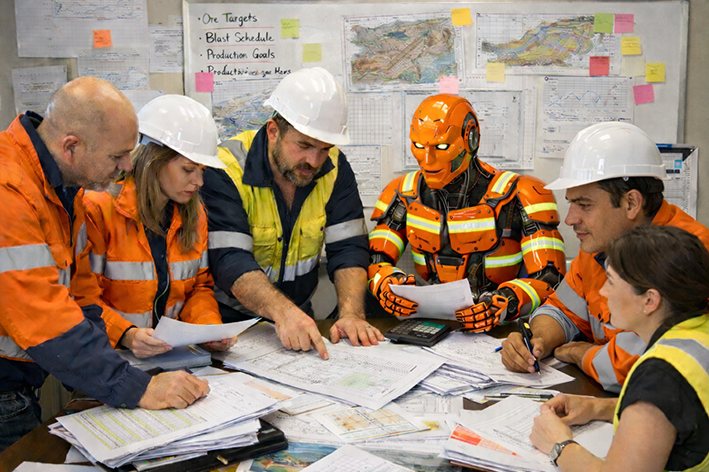
The image that leads this article shows a robot interacting with the usual players in a daily planning meeting. While this is currently a far-fetched (ai-generated) concept, imagine that robot as your AI agent. It can read and has access to historical data, decisions, outcomes and constraints. This means it can support supervisors and planners with informed recommendations in real time. Organisations with strong data foundations, visibility of decision-making, and integrated tooling across planning, execution and data capture can accomplish this.
Can this be achieved today? Possibly. The likelihood improves significantly with common data models and open data sharing between systems. The time is right for industry bodies and vendors to work together to prepare for this future.